The kasbah at Taliouine below a bare hillside.
Scenery on the wayJulian NyčaSourceCC BY-SA 3.0
Trip idea

Morocco Food Origins and Terroir in 14 Days

Fes 14 days
Map

The kasbah at Taliouine below a bare hillside.

Morocco Food Origins and Terroir in 14 Days connects Fes, Meknes, Marrakech.

Along the itinerary

Morocco Food Origins and Terroir in 14 Days is a 14-day, 13-night multi-stop itinerary built around city markets, craft-food systems, Atlantic ports, Souss agriculture, saffron country and Anti-Atlas terroir.

Along this route

Stops photographed · 8 / 8

Stop guides

Fès

Stop 1
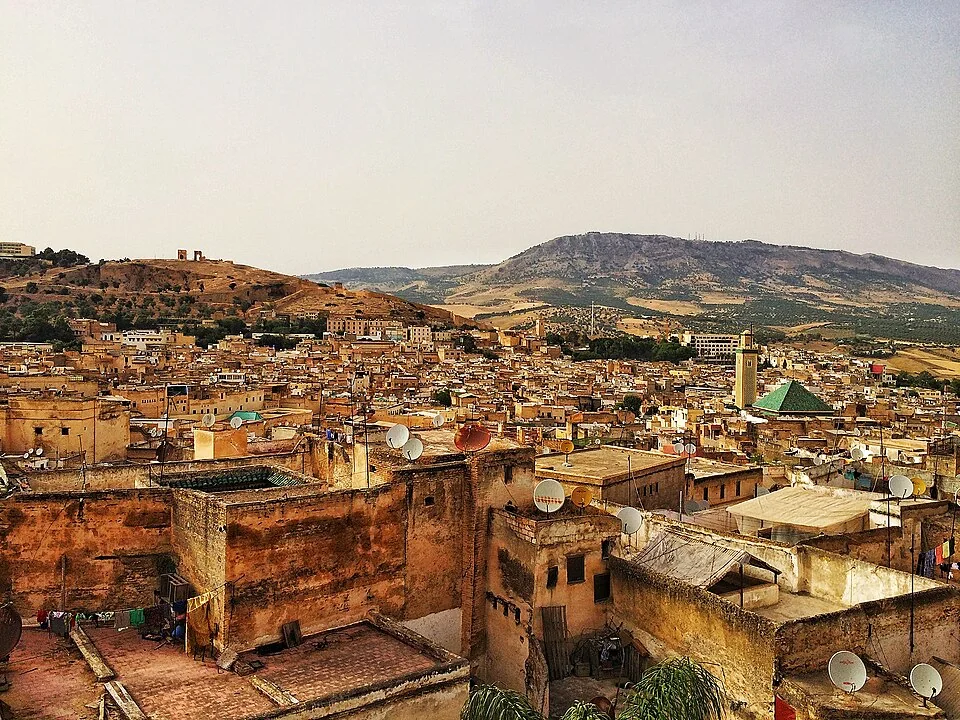
Rooftops across the medina of Fès.
Sim BrSourceCC BY-SA 2.0

Rooftops across the medina of Fès.

Start at Bab Boujloud to explore Fès el-Bali on foot. Beyond the old city, the gardens of Jnan Sbil lead towards the later quarter of Fès el-Jdid.

Arriving by rail? Use the station-to-medina guide to choose a gate where a vehicle can stop, then ask your host for the walking route to your door. Just inside Bab Boujloud, the courtyard of Bou Inania Madrasa brings carved cedar, stucco and tilework together.

Further into the lanes, the Nejjarine Museum shows the woodworker’s craft in a former caravanserai. If you want a second walk with a different rhythm, return towards Bab Boujloud and continue west to the Jnan Sbil gardens, between Fès el-Bali and Fès el-Jdid.

Fès

Meknes

Stop 2
A pedestrian beneath an arch outside the royal palace in Meknès.
Adam Jones, Ph.D.SourceCC BY-SA 3.0

A pedestrian beneath an arch outside the royal palace in Meknès.

In Meknès the imperial city meets the medina at Place El Hedim. The monuments here, the Roman remains at Volubilis and the hill town of Moulay Idriss are three distinct stops.

El Hedim and Bab Mansour

Start at Bab Mansour and the medina. From the square, look at the monumental gate before turning into the market streets. Check access on the day if there is a particular monument you want to enter.

Outside Meknès

Walk the Roman streets and look for the mosaics at Volubilis, then leave time for the steep lanes of Moulay Idriss Zerhoun. Both need transport back to Meknès. If your next overnight stop is Fès, allow for that onward journey as well.

Meknes

Marrakech

Stop 3
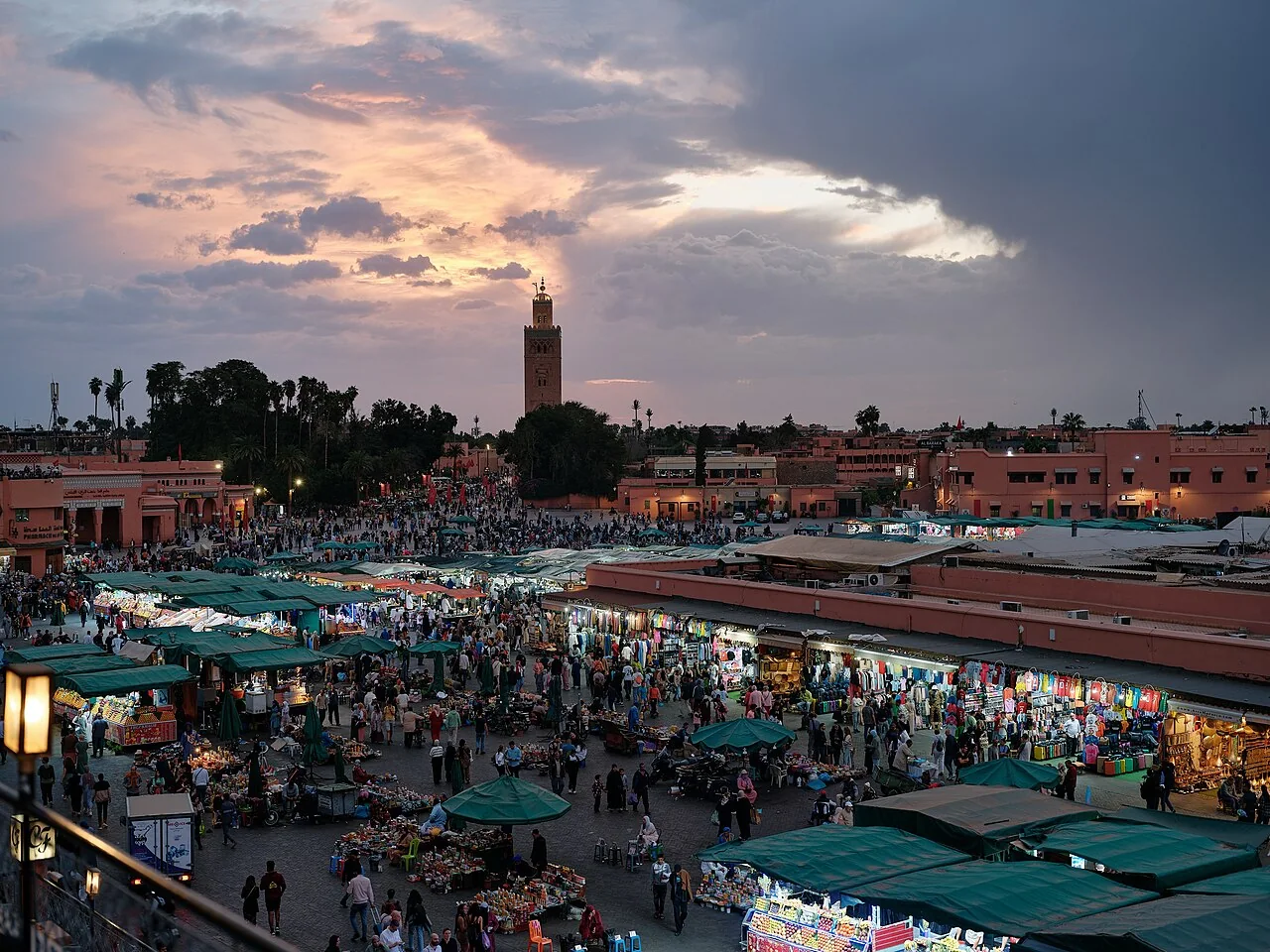
Market stalls fill Jemaa el-Fnaa at dusk, Marrakech.
HerokkSourceCC BY-SA 4.0

Market stalls fill Jemaa el-Fnaa at dusk, Marrakech.

From Jemaa el Fna, head north for the old college and souks, or south for palaces and royal tombs. Leave the gardens outside the walls for a separate outing.

Two walks from the square

Find Jemaa el Fna and look for the minaret of the Koutoubia to get your bearings. Marrakech grew from an eleventh-century Almoravid settlement. On the northern walk, the lanes of the souks lead towards the tilework and carved plaster of Ben Youssef Madrasa. For a craft visit, ask whether you will make something, watch a demonstration or visit a shop. Ask before photographing a workshop.

Palaces south of the medina

Choose the open courts and ruined walls of El Badi Palace, the carved decoration of the Saadian Tombs, or the rooms and gardens of Bahia Palace. Check the entrance for the visit you pick. Between sites, the lanes are also people's routes home. Leave doorways clear when stopping with a group.

A garden beyond the walls

For Jardin Majorelle, get your ticket through the garden’s official online ticket office before setting out. For water, olive trees and long views, choose the Menara gardens. Around Guéliz and Hivernage the broad streets make for a different walk from the medina. Allow time to cross town for a reservation.

Marrakech

Safi

Stop 4
Stacks of painted pottery in Safi.
Princedesmers01SourceCC BY-SA 4.0

Stacks of painted pottery in Safi.

Safi is a working Atlantic city where pottery, seafood, port life, surf reputation, Portuguese layers and industry meet. Safi is useful as a day trip, a craft stop, a seafood city or a road segment between Casablanca, El Jadida and Essaouira. Safi provides the clearest orientation point, while the surrounding routes open into imperial-city energy, Atlantic routes, Haouz plains and High Atlas gateways.

What makes the entry memorable is the relationship between pottery and port city, seafood, and surf history.

Safi

Taroudant

Stop 6
Towers and ramparts along the road in Taroudant.
Bjørn Christian TørrissenSourceCC BY-SA 3.0

Towers and ramparts along the road in Taroudant.

Taroudant’s earthen walls enclose two central squares and a network of covered market lanes. Assarag and Talmeklat make good landmarks for finding your way through the medina.

Between the two squares

From Place Assarag, take the covered craft lanes towards Place Talmeklat. Look for metalwork, leather and jewellery along the way. At Talmeklat, the shopping changes to everyday goods. The weekly market outside the walls is a separate stop.

Along the ramparts

Choose one gate and a stretch of the outer wall for an evening walk. If you are heading inland afterwards, Taliouine lies on the saffron-growing route. Agadir takes you back to the coast.

Taroudant

Taliouine

Stop 7
The kasbah at Taliouine below a bare hillside.
Julian NyčaSourceCC BY-SA 3.0

The kasbah at Taliouine below a bare hillside.

Taliouine is a saffron-growing town on the inland route from Taroudant. The Maison du Safran and local cooperatives are places to learn how the spice is produced.

Seeing saffron in season

Flower picking depends on the autumn harvest. Contact a cooperative before travelling if you hope to see work in the fields. At other times, ask about the dried threads or a dish prepared with saffron.

Beyond the saffron stop

The Ifri Imadidene granaries stand above a village outside Taliouine. Ask in the village for the custodian if you would like to visit. Allow time for the detour if you are driving back towards Taroudant.

Taliouine

Tafraoute

Stop 8
A minaret and rocky hills in Tafraoute.
Julian NyčaSourceCC BY-SA 3.0

A minaret and rocky hills in Tafraoute.

Pink granite rises around Tafraoute in the Anti-Atlas. The town market, the villages of the Ameln valley and the painted boulders are three different places to put on your map.

Granite and village walks

Start in town for crafts and provisions. In the Ameln valley, choose a village for a walk and ask locally which paths pass through the cultivated terraces. The painted boulders are a separate outing near the town.

The southern gorge road

The Aït Mansour valley takes you through a palm-lined gorge south of Tafraoute. Leave room for the winding return road. If you are travelling on to Tiznit, the Kerdous Pass lies on a different road west.

Tafraoute

Road map

The stop map is not available yet.

Fes