Build a northern heritage trip around Fes and Meknes, give Volubilis and Moulay Idriss Zerhoun a distinct outing, or continue into the Middle Atlas around Ifrane and Azrou.
Two cities that deserve different walks
Fes and Meknes belong together on a heritage itinerary, but give each its own questions. In Fes, focus on how the medina works: lanes, markets, craft production and the buildings around them. In Meknes, look at the relationship between the old town and its imperial monuments. Both are UNESCO World Heritage destinations, and each is more rewarding when you have time to look beyond a single landmark.
Choose a few visits per outing and leave the connecting streets as part of the experience. If you want a guided walk, describe your interests: architecture, craft techniques, Jewish heritage or food. Agree which interiors and admissions it includes. A broad promise to see everything is less useful than a clear route with places you genuinely want to understand.
Follow three different historical chapters
The medina of Fes, the imperial city of Meknes and Roman-era Volubilis do not represent one uniform historic Morocco. At Meknes, the monumental scale of Moulay Ismail’s imperial city changes that perspective. At Volubilis, excavated streets, public buildings and houses invite you to read an archaeological plan.
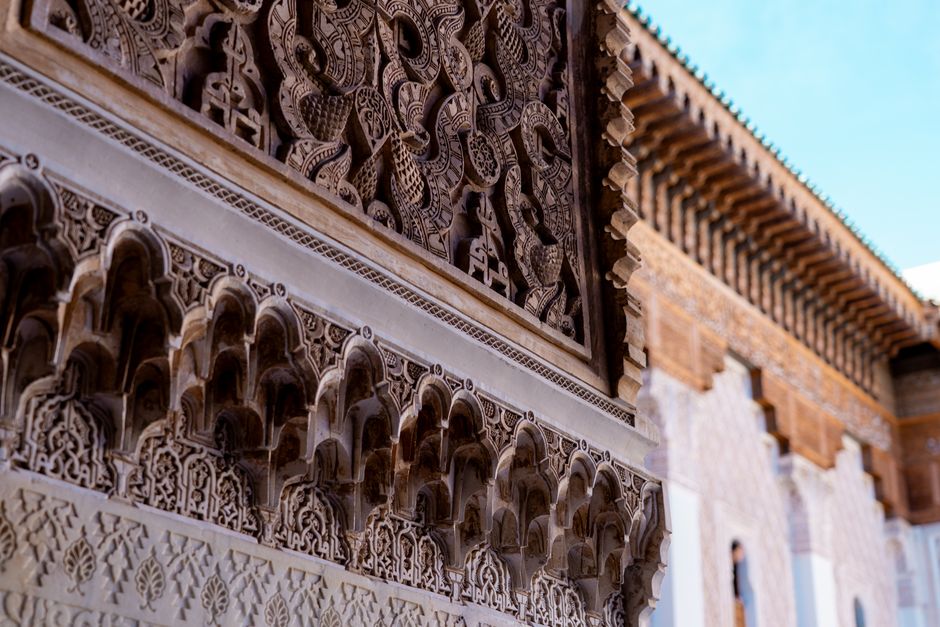
Choose a subject at each place before making the itinerary between them. You might compare how public space is arranged, how decoration is used or how water supports an urban settlement. A mosaic at Volubilis and carved or tiled decoration in a medina belong to different histories; noticing those differences is more rewarding than describing every stop as an imperial monument. Allow time to look, read and ask questions, as well as travel.
Keep Volubilis and Zerhoun distinct
The archaeological site of Volubilis and the town of Moulay Idriss Zerhoun offer different visits. One asks for time among excavated remains; the other is a living town. Plan shade, water and walking conditions for the site, then decide separately how much time to give the town. Do not let the drive between them become the entire outing.
Add the Middle Atlas for a change of setting
Ifrane and Azrou introduce forest and mountain landscapes. Treat that change as a new part of the trip, with its own accommodation and outdoor choices if those are your priorities. A woodland stop cannot stand in for a planned hike, and a town-centre pin does not identify a trailhead.
Ask about the actual route, weather exposure and return arrangements before heading into the hills. Leave wildlife space and avoid feeding animals. Where walking access is uncertain, choose a confirmed route rather than following a line across the map.
Make the connections work for your visits
Use the transport references to compare city arrivals and the road links to understand onward trips. A measured drive between cities does not include collecting luggage, finding accommodation or walking into a medina. Give arrival days a lighter programme. The strongest regional trip usually comes from choosing which places to explore properly, then adding another region only when the connections leave enough time.
23 destinations in Fes-Meknes
Every published destination in this region. Choose a city, town, village or landscape to explore its places and travel ideas.
FotoğrafçekenThis Photo was taken by Timothy A. Gonsalves. Feel free to use my photos, but please mention me as the author. I would much appreciate if you send me an email tagooty@yahoo.com or write on my talk page, for my information. Please contact me before commercial use. Please do not upload an edited image·Kaynak·CC BY-SA 4.0
Use the season filter for the places and itineraries you choose. Check current weather and local access before travelling; a regional label cannot predict conditions at every stop.
Family and access needs
Keep a manageable distance between stops. Ask the venue about steps, surfaces and facilities, and confirm child equipment with a service before booking.
Makers and photography
Ask permission before photographing people or entering workshops. Public visits, demonstrations and hands-on sessions have different access requirements.




 FotoğrafThis Photo was taken by Timothy A. Gonsalves. Feel free to use my photos, but please mention me as the author. I would much appreciate if you send me an email tagooty@yahoo.com or write on my talk page, for my information. Please contact me before commercial use. Please do not upload an edited imageKaynakCC BY-SA 4.0