 Itineraries
Tangier with Ksar Sghir, Fnideq, Oued Laou · 9-day itinerary
Start and finish in Tangier, visiting Ksar Sghir, Fnideq, Oued Laou, M'Diq, Tetouan and Chefchaouen. 8 stops across 9 days.
Kasbah, Tangier, Morocco
Along your itinerary
Places you’ll discover
This itinerary includes a full story and ordered stops. Check access, timetables and closures again before travel.
Road itinerary
Road itinerary distance and travel time are available for the full stop sequence.
Other road options
Compare road alternatives before choosing this day’s connection.
Open a day to read its visits, practical details and travel connections.
Before you go
Get to know the places on your itinerary
Read what makes each place worth a visit and choose how you want to spend your time there. The stop sequence above keeps your day assignments; these guides help you shape the visits.
Explore Tangier through the medina, Kasbah, art and waterfront, with a separate plan for the Atlantic edge. Choose the right arrival point and leave time to see how the city changes between its quarters.
Begin with a connected city walk
Tangier’s medina, Kasbah and waterfront offer different views of the same city. Start with a walk that connects a few places you want to understand, rather than moving between isolated photo stops. The streets around the Kasbah are part of a residential quarter, so keep doorways clear and ask before photographing people.
For an introductory visit, choose a medina walk and one museum or cultural stop. Leave time for the approach, a café pause and the views between them. A city visit becomes easier to follow when you know why the next place belongs in the walk: a change in architecture, a new view of the Strait or another chapter of Tangier’s cultural history.
Use the squares to understand the climb
The Grand Socco, the medina streets and the higher Kasbah give a city walk a readable progression from public square to old-town neighbourhood and elevated views. Give the climb a purpose: street life first, then a particular cultural visit, then a pause looking toward the Strait. Reverse the order if the approach suits your accommodation better; this is a suggested way of reading the city, rather than a timed walking circuit.
Tangier’s artistic history is easier to follow through individual places than a list of famous visitors. A museum collection, the American Legation and a historic street can lead to quite different conversations. Choose one of those themes and leave time to read what is actually on display. The buildings and institutions are part of the visit, not interchangeable backdrops for a photograph.
Choose the museum you actually want to visit
The Tangier Kasbah Contemporary Art Museum and the Kasbah Museum of Mediterranean Cultures are different institutions. The contemporary art museum occupies a former prison; the Mediterranean cultures museum is associated with the former sultan’s palace. Check the current programme and visitor arrangements for the one you intend to see.
The American Legation offers another cultural visit within the medina. If several interiors interest you, spread them across your stay instead of leaving only a few minutes for each. An archive image of a quarter can introduce the setting without showing a current exhibition or a particular entrance.
Stop 2
Ksar Sghir

Ksar es-Seghir or Ksar Sghir or al-Qasr al-Seghir (Arabic القصر الصغير), is a small town on the Mediterranean coast in the Jebala region of northwest Morocco, between Tangier and Ceuta
In Tangier-Tetouan-Al Hoceima, Ksar Sghir connects strait and port corridor.
A sense of place
Ksar Sghir is a small coastal town on the Strait corridor between Tangier and Tetouan or Ceuta-side routes. Ksar Sghir's value lies in port and strait geography, coastal movement, seafood, road stops and proximity to major transport infrastructure. Ksar Sghir connects naturally with Tangier, Tangier Med, Fnideq, Tetouan, coastal drives and ferry or port routing.
Ksar Sghir can support restaurants, drivers, short stops, photography and travel logistics while helping distinguish Tangier city movement from Tangier Med and eastern strait movement.
Coastal fort and ferry corridor, earthen settlement, and tangier med shape the experience of Ksar Sghir, while the surrounding territory places it inside Strait gateways, Andalusi cities, Rif mountains and Mediterranean coves.
Ksar Sghir provides the clearest orientation point, while the surrounding routes open into Strait gateways, Andalusi cities, Rif mountains and Mediterranean coves.
What makes the entry memorable is the relationship between coastal fort and ferry corridor, earthen settlement, and tangier med.

In Tangier-Tetouan-Al Hoceima, Fnideq connects strait and shopping.
A sense of place
Fnideq is a strait-side town connected to shopping, coastal movement, family summer travel, restaurants, nearby beaches and the northern border/port corridor.
This combination gives Fnideq a clear role in the wider Moroccan itinerary.
The experience gains depth through border coastal city, gateway, and Mediterranean coast, which can be explored at different speeds depending on the season, the traveler and the wider route.
Stop 4
Oued Laou

The lush shore of Oued Laou: beautiful green hills on the Mediterranean sea in the north of Morocco.
Oued Laou is a Mediterranean seaside destination in the wider Tétouan travel area. Choose your coastal stop, compare the road approach and give the town its own place in a northern Morocco itinerary.
Time by the Mediterranean
The Moroccan National Tourism Office presents Oued Laou as part of the coastline around Tétouan. Start with the part of the shore you want to visit, rather than assuming one map point represents every beach access.
Make room for the approach
Compare the road connection with your actual departure location. Confirm the entrance, parking and onward transport before fixing several coastal visits into one day. Check local sea conditions and posted guidance at the beach.
Explore Martil, Tétouan and other northern destinations in the Tangier-Tétouan-Al Hoceima travel guide.
Stop 5
M'diq
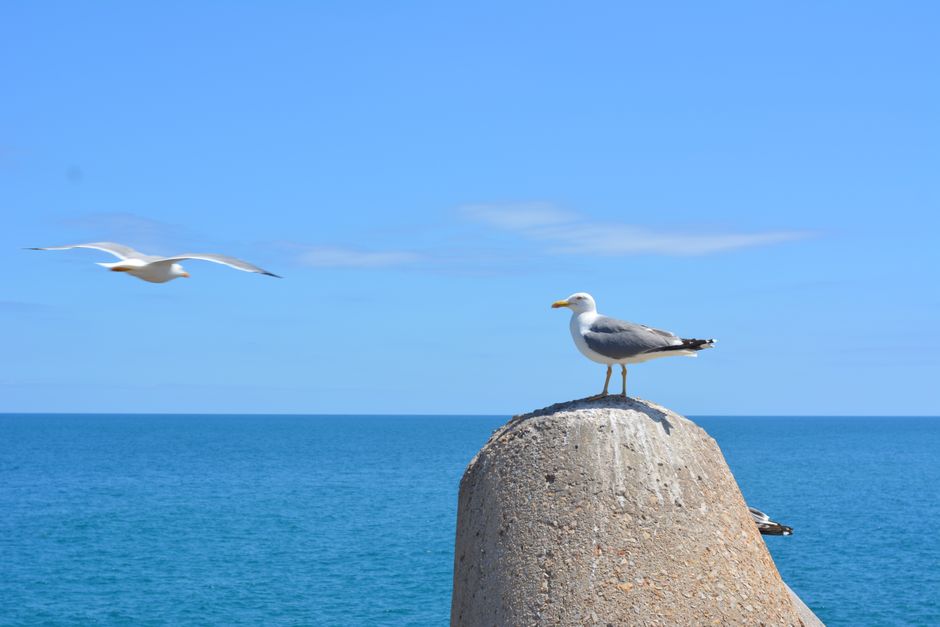
Two seagulls by the ocean in Al Hoceima, Morocco, with clear blue skies.
M'diq is a coastal town on the Mediterranean side of northern Morocco. It is a distinct destination from Fnideq and Tetouan, even though their names often appear together in regional travel information. Choose the town and shoreline you want to visit before comparing places to stay or onward travel.
M'diq and the Mediterranean coast
M'diq belongs to the coastal side of the Tangier–Tetouan–Al Hoceima region. Its town, harbour and nearby shoreline form one destination; Fnideq is a separate town farther along the coast.
Choose the right destination
Keep accommodation addresses and meeting points attached to their actual town. A regional label such as M'diq-Fnideq describes a wider administrative area and is not a single hotel zone.
Continue exploring
Connect a coastal stay with Tetouan, or compare places around M'diq. Check the actual approach roads when combining more than one stop.

Tetouan's UNESCO-listed medina preserves a strong Andalusian architectural inheritance beneath the Rif mountains. Its craft streets and historic houses make a distinct city visit. The Mediterranean coast and Chefchaouen belong to separate outings, rather than extensions of one short medina walk.
A lived-in historic city
Explore the medina through its public streets and working shops. The heritage lies in the wider urban fabric as well as individual buildings; private homes remain private.
Different layers of architecture
The streets outside the medina add another chapter, with buildings shaped by the city's Spanish protectorate period. Combine the two areas when architecture is the focus of your visit.
From city to mountains
Chefchaouen offers a different mountain town. Tangier faces the Strait. Compare them in the regional guide before choosing your next stay.
Stop 7
Chefchaouen

Explore the iconic blue-hued buildings of Chefchaouen, Morocco, featuring traditional architecture and vibrant facades.
Explore Chefchaouen as a living Rif town, with time for its medina and a separately chosen mountain outing. Plan the walking, photography and onward connection around your group’s pace.
Look beyond the blue photograph
Chefchaouen’s medina and Rif setting give a visit more depth than a succession of doorways. Choose a walk through the town and leave room for its public spaces, shops and ordinary streets. The blue buildings form a residential landscape, so ask before portraits and keep entrances clear while taking photographs.
Start with a few places you want to see, then let the streets between them become part of the visit. If photography is your main interest, choose a route that does not repeatedly bring you back through the same narrow lanes. Wait for space rather than blocking people going about their day.
Give the walk a subject beyond colour
Uta el-Hammam square and the Kasbah provide a recognisable focus within the old town. The Kasbah’s garden and heritage displays change the pace from the streets around it, while Ras El Ma brings water and the mountain edge into the visit. Choose a sequence around those different settings, with time to notice the town between them.
Woodworking, wool and weaving give craft-minded travellers another reason to slow down. Look at materials and techniques rather than judging every object only by its colour. Beyond the town, Akchour and Talassemtane belong to a separate outdoor plan. A town walk can help you get your bearings before a mountain outing, but it does not replace choosing a trail, its starting point and the time needed to return.
Match the walk to the group
Ask about steps, gradients and the practical approach to your accommodation. A medina address may need a final walk with luggage, and an attractive view can involve more climbing than the map suggests. Agree a meeting point with a driver or host before arrival if that matters to the group.
For families or anyone who prefers a gentler pace, choose a shorter outing and keep another part of the day flexible. A guide can help shape a walk around interests and access needs when you explain them clearly in advance.
Travelling between your stops
Compare the connections below when deciding where to stay and how much of each day to leave for visits. Driving estimates exclude traffic, breaks and time at attractions. Dated timetable references describe the collected services; check your travel date with the operator.
Tangier → Ksar Sghir
Road · 40.3 km · 35 min
Estimated drive on the mapped road network. Travel time on site is additional.
Map and routing attributionKsar Sghir → Fnideq
Road · 31.9 km · 35 min
Estimated drive on the mapped road network. Travel time on site is additional.
Map and routing attributionFnideq → Oued Laou
Road · 73.1 km · 1 h 11 min
Estimated drive on the mapped road network. Travel time on site is additional.
Map and routing attributionOued Laou → M'Diq
Road · 51.9 km · 58 min
Estimated drive on the mapped road network. Travel time on site is additional.
Map and routing attributionM'Diq → Tetouan
Road · 16.6 km · 18 min
Estimated drive on the mapped road network. Travel time on site is additional.
Map and routing attributionTetouan → Chefchaouen
Road · 60.8 km · 1 h 13 min
Estimated drive on the mapped road network. Travel time on site is additional.
Map and routing attributionChefchaouen → Tangier
Road · 108.6 km · 1 h 59 min
Estimated drive on the mapped road network. Travel time on site is additional.
Map and routing attribution
Make this itinerary yours
Add these stops to your current itinerary, then adjust the order and your travel preferences. This does not book transport, accommodation or activities.
Recheck transport, tickets, opening hours and access before travel.