 Itineraries
Agadir to Taroudant via Taghazout, Tamraght, Imsouane · 10-day itinerary
Travel from Agadir to Taroudant, visiting Taghazout, Tamraght, Imsouane, Essaouira, Mirleft, Sidi Ifni and Tafraoute. 9 stops across 10 days.
a beach with a hill in the background
Along your itinerary
Places you’ll discover
This itinerary includes a full story and ordered stops. Check access, timetables and closures again before travel.
Road itinerary
Road itinerary distance and travel time are available for the full stop sequence.
Other road options
Compare road alternatives before choosing this day’s connection.
Open a day to read its visits, practical details and travel connections.
Before you go
Get to know the places on your itinerary
Read what makes each place worth a visit and choose how you want to spend your time there. The stop sequence above keeps your day assignments; these guides help you shape the visits.
Stop 1
Agadir
a beach with a hill in the background
Use Agadir for an Atlantic stay with city visits, markets and carefully chosen surf or inland outings. Compare the seafront, your accommodation and actual activity meeting points before planning each day.
Choose how you want to spend an Atlantic stay
Agadir works well when you decide what should lead the trip: beach time, a comfortable urban stay, markets, surf lessons or a combination of coastal and inland visits. The seafront and the rest of the city offer different experiences. Choose accommodation by its exact location and the trips you expect to make, rather than by the city name alone.
Leave some days with a single focus. A market visit and an unhurried meal can fill an outing without needing another distant attraction. A beach day does not have to include a full regional tour. That flexibility is particularly useful for families or groups whose interests and energy levels differ.
Let the Souss appear in the city visit
Souk El Had introduces the city through food and everyday shopping: fruit, spices, clothing and household goods share the market with craft products. Choose an interest before entering, then let that guide your questions. Looking at ingredients for a meal gives a food walk a different purpose from searching for leatherwork or a metal object.
The wider Souss is associated with argan production and with jewellery traditions around places such as Tiznit and Taroudant. For an argan visit, ask to understand the production stages and distinguish an oil intended for cooking from a cosmetic product. In a jewellery shop, discuss material, workmanship and origin directly. These are useful subjects for a visit without assuming that every shop offers a demonstration or that every cooperative is open to unannounced groups.
See the market as part of the city
Souk El Had offers an opportunity to explore shopping and everyday trade. Decide whether you want to browse, buy specific goods or join a guided visit that explains products and their use. Ask before photographing stallholders or entering working spaces, and agree any purchases directly.
Food and ingredient pages can help you recognise something you want to try or understand. They are an introduction to culinary traditions, rather than evidence that a particular stall or restaurant has the item available. Ask about preparation and ingredients, especially when dietary requirements affect your choice.

Taghazout is a working Atlantic village and international surf base north of Agadir, not simply a beach label. Its value comes from the relationship between village streets, fishing and food culture, surf breaks, coastal walks, camp stays and the wider Tamraght-Tamri-Imsouane corridor.
A sense of place
Taghazout is a working Atlantic village and international surf base north of Agadir, not simply a beach label. Its value comes from the relationship between village streets, fishing and food culture, surf breaks, coastal walks, camp stays and the wider Tamraght-Tamri-Imsouane corridor.
Use Taghazout as an overnight coast base when surf, village rhythm or nearby exploration matters; a short photo stop misses the early and late parts of the day and should not inherit live surf conditions from a forecast-free page. Taghazout often takes 240-720 minutes on site; travel, queues, meals and separately booked services require additional time.
The place is best suited to surfer, couple, digital nomad, food, slow travel. It should be avoided or redesigned for travelers seeking a quiet resort without village or surf activity, travelers needing verified step free old village access.
Before you go
- Best for: surfer, couple, digital nomad, food, slow travel
- Time needed: 240-720 minutes, excluding transfer and queues
- Best season or time: Surf and swimming conditions vary daily; autumn through spring is important for swell, while summer emphasizes beach and domestic demand.
- Transport difficulty: easy by road but live traffic and parking check required
- Accessibility: unknown; no step-free claim without a local audit
Plan your visit
Use Taghazout as an overnight coast base when surf, village rhythm or nearby exploration matters; a short photo stop misses the early and late parts of the day and should not inherit live surf conditions from a forecast-free page.
- Recommended local window: 240-720 minutes
- Season and weather setting: Surf and swimming conditions vary daily; autumn through spring is important for swell, while summer emphasizes beach and domestic demand.
- Common mistake: Treating every Taghazout stay as beachfront or every day as suitable for the same surf level.
- Live checks: opening, religious or operational access, admissions, weather, tide, crowd restrictions and transport as applicable

Tamraght is part of the Agadir-Taghazout surf corridor, but it has its own function. It is more spread out than Taghazout, with surf camps, guesthouses, cafés, yoga spaces, board rentals, roadside food and easier access to Devil’s Rock, Banana Point, Aourir and Agadir. It often works better for travelers who want surf services without staying directly inside Taghazout village. Tamraght is best understood as a practical surf-camp and long-stay base.
A sense of place
Tamraght is part of the Agadir-Taghazout surf corridor, but it has its own function. It is more spread out than Taghazout, with surf camps, guesthouses, cafés, yoga spaces, board rentals, roadside food and easier access to Devil’s Rock, Banana Point, Aourir and Agadir. It often works better for travelers who want surf services without staying directly inside Taghazout village.
Tamraght is best understood as a practical surf-camp and long-stay base.
The local setting brings together surf and yoga village, surf schools, and hostels; this combination is what gives Tamraght its own travel rhythm.
From Tamraght, the itinerary connects naturally to the broader pattern of Agadir’s coast, surf villages, argan country and Anti-Atlas gateways.
The experience gains depth through surf and yoga village, surf schools, and hostels, which can be explored at different speeds depending on the season, the traveler and the wider route.

Imsouane is a remote-feeling fishing and surf village on the Atlantic route between Agadir and Essaouira. The bay, fishing activity, cliff-backed coastline and long-stay surf rhythm make Imsouane an overnight destination whose value depends on sea conditions, road access and respect for village life.
A sense of place
Imsouane is a remote-feeling fishing and surf village on the Atlantic route between Agadir and Essaouira. The bay, fishing activity, cliff-backed coastline and long-stay surf rhythm make Imsouane an overnight destination whose value depends on sea conditions, road access and respect for village life.
Allocate at least one night when Imsouane is more than a transfer stop; the road approach and variable surf conditions make a rushed same-day return less resilient than a daylight arrival with a backup coastal plan. Imsouane often takes 240-720 minutes on site; travel, queues, meals and separately booked services require additional time.
The place is best suited to surfer, photographer, couple, road trip, slow travel. It should be avoided or redesigned for travelers requiring urban services or guaranteed flat access, inexperienced swimmers without local conditions guidance.
Before you go
- Best for: surfer, photographer, couple, road trip, slow travel
- Time needed: 240-720 minutes, excluding transfer and queues
- Best season or time: Wind, swell and currents require daily checks; seasonal crowd and road conditions can change the practical experience.
- Transport difficulty: road transfer required
- Accessibility: unknown; no step-free claim without a local audit
Plan your visit
Allocate at least one night when Imsouane is more than a transfer stop; the road approach and variable surf conditions make a rushed same-day return less resilient than a daylight arrival with a backup coastal plan.
- Recommended local window: 240-720 minutes
- Season and weather setting: Wind, swell and currents require daily checks; seasonal crowd and road conditions can change the practical experience.
- Common mistake: Building the day around a famous wave without a safe non-surf alternative.
- Live checks: opening, religious or operational access, admissions, weather, tide, crowd restrictions and transport as applicable
Stop 5
Essaouira

Colorful fishing boats densely packed in the historic harbor of Essaouira, Morocco.
Explore Essaouira’s World Heritage medina, ramparts and working port on foot, then choose a beach or water activity to suit current conditions. Leave room for art, food and the Atlantic setting.
Let the medina and sea shape the stay
Essaouira brings a walled medina, Atlantic waterfront and working fishing port into a compact city visit. Its UNESCO-listed medina rewards time on foot: choose a few places of interest and enjoy the streets between them. A visit can move naturally from architecture to a gallery, a meal or a view of the sea without needing a transfer at every stage.
If you arrive after a longer drive, leave the first outing simple. Find your accommodation, identify a meeting point for luggage or onward transport and take a walk that helps you understand the relationship between the medina, port and beach. The city becomes easier to enjoy when you stop treating each area as a separate attraction to complete.
Read a port town through its defences
Essaouira’s fortified town took shape in the eighteenth century as an international trading port. Its urban heritage brings European military planning into a North African setting, with the ramparts, streets and maritime edge forming a connected whole. That helps explain why the city feels different from an inland imperial medina. Walk with the relationship between town and harbour in mind, rather than looking at the walls only as a viewpoint.
For a second theme, give attention to the city’s craft life. Thuya woodwork and marquetry offer a different way to look closely: a small box or inlaid surface can reveal decisions about grain, pattern and finish. Art, music and trade belong to the same city story, but do not need to be fitted into one organised experience. Leave time to follow the subject that holds your attention.
See the ramparts and working port with attention
The Skala and ramparts give the visit an architectural and maritime focus. Check current access to the part you intend to enter. The surrounding public streets and an admitted monument may have different arrangements.
At the port, leave space for people moving equipment and carrying out their work. Ask before taking close photographs of workers, and do not enter restricted working areas for a better view. A fishing-port visit can add context to a seafood meal without implying that a particular catch or restaurant menu is guaranteed.

Mirleft is an Atlantic coastal town in Sidi Ifni province, with beaches set below rocky headlands. Legzira lies farther south on the coast toward Sidi Ifni, making it a separate outing from the town. Choose beach walks around the tide and local access conditions.
Mirleft is an Atlantic coastal town in Sidi Ifni province, with beaches set below rocky headlands. Legzira lies farther south on the coast toward Sidi Ifni, making it a separate outing from the town.
Choose beach walks around the tide and local access conditions. Ask locally about surf and currents before entering the water, and leave distance between yourself and unstable cliffs or arches.
Stop 7
Sidi Ifni
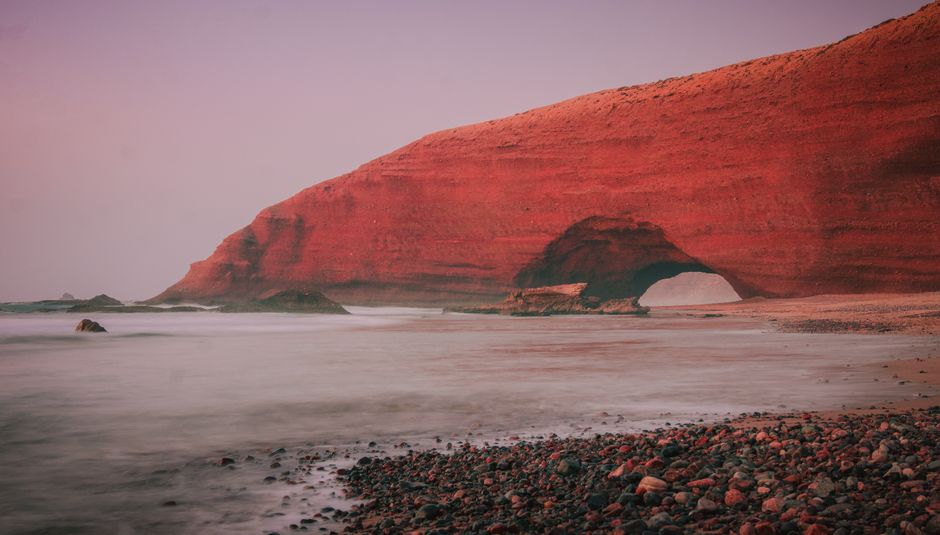
Stunning view of a large red rock arch on a misty beach during twilight, creating a serene atmosphere.
In Guelmim-Oued Noun, Sidi Ifni connects south coast and architecture.
A sense of place
Sidi Ifni is a southern Atlantic town with sea cliffs, Spanish-era architecture, blue-white urban details, cafés, fishing life, nearby beaches and access to Mirleft, Legzira and Guelmim routes. Sidi Ifni's value is atmosphere: it feels slower, more remote and more architectural than many coastal stops. Sidi Ifni connects naturally with Mirleft, Aglou, Legzira setting, Guelmim, Fort Bou Jerif and southern road trips.
Sidi Ifni adds a distinctive southern coastal identity.
The appeal of Sidi Ifni comes from the meeting of art deco Atlantic town, Atlantic cliffs, and spanish-era architecture, not from a single attraction.
From Sidi Ifni, the itinerary connects naturally to the broader pattern of Anti-Atlas foothills, Sahara-edge oases and wild southern Atlantic roads.
This combination gives Sidi Ifni a clear role in the wider Moroccan itinerary.
A useful visit is built around art deco Atlantic town, Atlantic cliffs, and spanish-era architecture.

In Souss-Massa, Tafraoute connects anti-Atlas and food.
A sense of place
Tafraoute is a slow Anti-Atlas base defined by granite landscapes, almond valleys, painted rocks, mountain roads, village routes, cycling, climbing, guesthouses and local food. It is a destination for travelers who want space, color, geology and quiet rather than crowded monuments. The experience connects naturally with Tafraoute to Aït Mansour, Jbel el Kest, Anti-Atlas granaries, almonds, amlou, cycling routes and photo stops.
Commercial opportunities include guesthouses, guides, bike rentals, climbing support, local meals, almond products and road-trip loops.
The local setting brings together Anti-Atlas mountain town, granite landscapes, and almond blossom; this combination is what gives Tafraoute its own travel rhythm.
For many visitors, Tafraoute becomes a mountain or nature base with routes into the surrounding landscape; the surrounding streets, roads and services then determine how long the stop deserves.
That local balance gives Tafraoute a purpose beyond simple map coverage.
A strong itinerary gives priority to Anti-Atlas mountain town, granite landscapes, and almond blossom, using the rest of the visit to support rather than distract from those defining qualities.
Stop 9
Taroudant

A historical adobe village in a desert, showcasing traditional Middle Eastern architecture.
In Souss-Massa, Taroudant connects walled market and food.
A sense of place
Taroudant is a walled market city that gives travelers a calmer alternative to larger medinas. Its ramparts, souks, carriage routes, nearby oases, argan and honey territories, and access to the Anti-Atlas make it useful as both a day trip from Agadir and a deeper southern base.
The local setting brings together walled market city, ramparts, and souks; this combination is what gives Taroudant its own travel rhythm.
The most useful regional connection is through Taroudant, which places the experience within Agadir’s coast, surf villages, argan country and Anti-Atlas gateways.
The experience gains depth through walled market city, ramparts, and souks, which can be explored at different speeds depending on the season, the traveler and the wider route.
Travelling between your stops
Compare the connections below when deciding where to stay and how much of each day to leave for visits. Driving estimates exclude traffic, breaks and time at attractions. Dated timetable references describe the collected services; check your travel date with the operator.
Agadir → Taghazout
Road · 24.5 km · 24 min
Estimated drive on the mapped road network. Travel time on site is additional.
Map and routing attributionTaghazout → Tamraght
Road · 8.2 km · 8 min
Estimated drive on the mapped road network. Travel time on site is additional.
Map and routing attributionTamraght → Imsouane
Road · 77.9 km · 1 h 29 min
Estimated drive on the mapped road network. Travel time on site is additional.
Map and routing attributionImsouane → Essaouira
Road · 99.2 km · 1 h 35 min
Estimated drive on the mapped road network. Travel time on site is additional.
Map and routing attributionEssaouira → Mirleft
Road · 309.3 km · 4 h 59 min
Estimated drive on the mapped road network. Travel time on site is additional.
Map and routing attributionMirleft → Sidi Ifni
Road · 31.5 km · 40 min
Estimated drive on the mapped road network. Travel time on site is additional.
Map and routing attributionSidi Ifni → Tafraoute
Road · 179.5 km · 3 h 27 min
Estimated drive on the mapped road network. Travel time on site is additional.
Map and routing attributionTafraoute → Taroudant
Road · 147.6 km · 3 h 1 min
Estimated drive on the mapped road network. Travel time on site is additional.
Map and routing attribution
Make this itinerary yours
Add these stops to your current itinerary, then adjust the order and your travel preferences. This does not book transport, accommodation or activities.
Recheck transport, tickets, opening hours and access before travel.