 Itineraries
Marrakech to Agadir via Taroudant, Taliouine, Tafraoute · 8-day road itinerary
Travel from Marrakech to Agadir, visiting Taroudant, Taliouine, Tafraoute, Tiznit, Mirleft and Sidi Ifni. 8 stops across 8 days.
Jemaa el-Fnaa and the Marrakech skyline at sunset.
Along your itinerary
Places you’ll discover
This itinerary includes a full story and ordered stops. Check access, timetables and closures again before travel.
Road itinerary
Road itinerary distance and travel time are available for the full stop sequence.
Other road options
Compare road alternatives before choosing this day’s connection.
Open a day to read its visits, practical details and travel connections.
Before you go
Get to know the places on your itinerary
Read what makes each place worth a visit and choose how you want to spend your time there. The stop sequence above keeps your day assignments; these guides help you shape the visits.
Explore Marrakech through connected medina walks, gardens and historic buildings, then choose whether an Atlas or Atlantic extension belongs in your trip. Leave time for the city between its landmarks.
Find your rhythm before filling the itinerary
Marrakech rewards a plan with a little space in it. The medina, gardens, historic buildings and newer neighbourhoods offer different ways to spend a day. Choose the part of the city that interests you most, then build a walk around a few nearby visits. The UNESCO-listed medina is a living urban place, with homes and working streets between its major sights.
For an initial outing, use Jemaa el Fna as a point of orientation and explore the medina at a pace that leaves room to stop. Return to a familiar meeting point rather than turning every lane into another item to complete. If shopping is important, give it its own time so that a museum or garden booking does not become a deadline hanging over the walk.
Recognise the layers of the old city
Marrakech began as an Almoravid foundation in the eleventh century and developed through successive dynasties. That history is visible at different scales: the Koutoubia as a city landmark, the defensive circuit of walls and gates, and the more enclosed settings of palaces, tombs and religious learning. Ben Youssef Madrasa, the Badi Palace and the Saadian Tombs each offer a different architectural subject. Choose the one that most interests you rather than expecting three interiors to tell the same story.
Try looking at one material as you walk: cut tile, carved plaster, wood or garden water. Following a detail from a major building into an ordinary courtyard helps connect monumental Marrakech to its domestic architecture. Keep the square and souks for another part of the outing, when you can enjoy their activity without rushing toward a closing door.
Give each major visit a clear place in the day
Choose a garden or historic interior because you want to spend time there. Jardin Majorelle has its own visitor arrangements; check them before planning the rest of the day around it. The Menara gardens offer a different setting from the medina. Gueliz and Hivernage introduce another part of Marrakech, with wider streets and a different urban atmosphere.
Avoid combining distant visits solely because they appear on the same must-see list. Compare their exact locations and leave time for the connecting trip, a meal and a rest. Travellers who prefer a gentler pace can choose one main visit and an unhurried neighbourhood walk rather than several separate transfers.
Stop 2
Taroudant

A historical adobe village in a desert, showcasing traditional Middle Eastern architecture.
In Souss-Massa, Taroudant connects walled market and food.
A sense of place
Taroudant is a walled market city that gives travelers a calmer alternative to larger medinas. Its ramparts, souks, carriage routes, nearby oases, argan and honey territories, and access to the Anti-Atlas make it useful as both a day trip from Agadir and a deeper southern base.
The local setting brings together walled market city, ramparts, and souks; this combination is what gives Taroudant its own travel rhythm.
The most useful regional connection is through Taroudant, which places the experience within Agadir’s coast, surf villages, argan country and Anti-Atlas gateways.
The experience gains depth through walled market city, ramparts, and souks, which can be explored at different speeds depending on the season, the traveler and the wider route.

Taliouine is one of the clearest places to explain Morocco through terroir. Known for saffron, it sits between High Atlas roads, Anti-Atlas landscapes, cooperatives, village agriculture and routes toward Ouarzazate or Taroudant. The appeal of Taliouine comes from the meeting of saffron and mountain town, siroua, and cooperatives, not from a single attraction. From Taliouine, the itinerary connects naturally to the broader pattern of Agadir’s coast, surf villages, argan country and Anti-Atlas gateways.
A sense of place
Taliouine is one of the clearest places to explain Morocco through terroir. Known for saffron, it sits between High Atlas roads, Anti-Atlas landscapes, cooperatives, village agriculture and routes toward Ouarzazate or Taroudant.
The appeal of Taliouine comes from the meeting of saffron and mountain town, siroua, and cooperatives, not from a single attraction.
From Taliouine, the itinerary connects naturally to the broader pattern of Agadir’s coast, surf villages, argan country and Anti-Atlas gateways.
This combination gives Taliouine a clear role in the wider Moroccan itinerary.
A useful visit is built around saffron and mountain town, siroua, and cooperatives.

In Souss-Massa, Tafraoute connects anti-Atlas and food.
A sense of place
Tafraoute is a slow Anti-Atlas base defined by granite landscapes, almond valleys, painted rocks, mountain roads, village routes, cycling, climbing, guesthouses and local food. It is a destination for travelers who want space, color, geology and quiet rather than crowded monuments. The experience connects naturally with Tafraoute to Aït Mansour, Jbel el Kest, Anti-Atlas granaries, almonds, amlou, cycling routes and photo stops.
Commercial opportunities include guesthouses, guides, bike rentals, climbing support, local meals, almond products and road-trip loops.
The local setting brings together Anti-Atlas mountain town, granite landscapes, and almond blossom; this combination is what gives Tafraoute its own travel rhythm.
For many visitors, Tafraoute becomes a mountain or nature base with routes into the surrounding landscape; the surrounding streets, roads and services then determine how long the stop deserves.
That local balance gives Tafraoute a purpose beyond simple map coverage.
A strong itinerary gives priority to Anti-Atlas mountain town, granite landscapes, and almond blossom, using the rest of the visit to support rather than distract from those defining qualities.

In Souss-Massa, Tiznit connects craft and food.
A sense of place
Tiznit is a southern craft city known especially for silver, but its role is wider. It links Agadir, Aglou, Mirleft, Legzira, Tafraoute and Anti-Atlas routes. Important distinctions include its medina, walls, silver souk, craft verification, local food, coastal access and position as a gateway to deeper Souss and Guelmim routes.
The most useful regional connection is through Tiznit, which places the experience within Agadir’s coast, surf villages, argan country and Anti-Atlas gateways.
The local rhythm is visible in silver and walled city, silver souk, and medina walls.

Mirleft is an Atlantic coastal town in Sidi Ifni province, with beaches set below rocky headlands. Legzira lies farther south on the coast toward Sidi Ifni, making it a separate outing from the town. Choose beach walks around the tide and local access conditions.
Mirleft is an Atlantic coastal town in Sidi Ifni province, with beaches set below rocky headlands. Legzira lies farther south on the coast toward Sidi Ifni, making it a separate outing from the town.
Choose beach walks around the tide and local access conditions. Ask locally about surf and currents before entering the water, and leave distance between yourself and unstable cliffs or arches.
Stop 7
Sidi Ifni
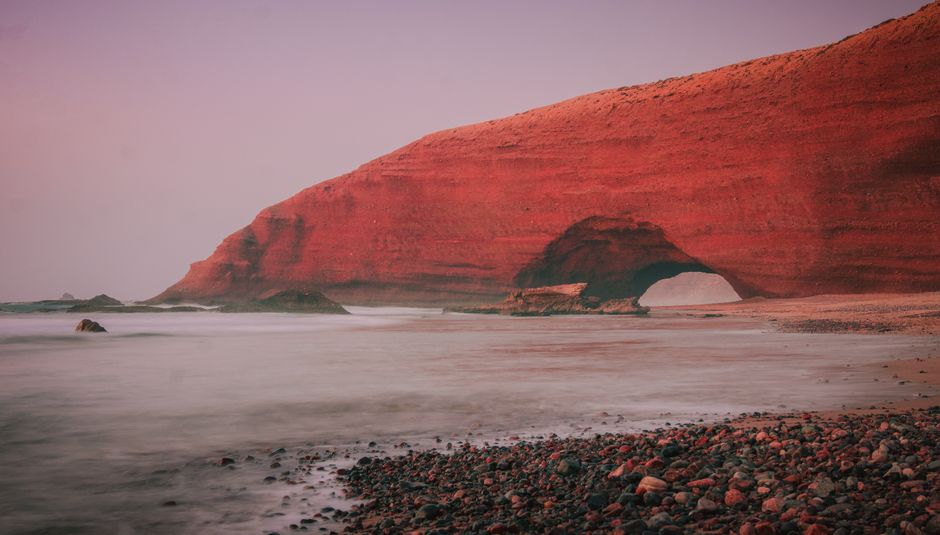
Stunning view of a large red rock arch on a misty beach during twilight, creating a serene atmosphere.
In Guelmim-Oued Noun, Sidi Ifni connects south coast and architecture.
A sense of place
Sidi Ifni is a southern Atlantic town with sea cliffs, Spanish-era architecture, blue-white urban details, cafés, fishing life, nearby beaches and access to Mirleft, Legzira and Guelmim routes. Sidi Ifni's value is atmosphere: it feels slower, more remote and more architectural than many coastal stops. Sidi Ifni connects naturally with Mirleft, Aglou, Legzira setting, Guelmim, Fort Bou Jerif and southern road trips.
Sidi Ifni adds a distinctive southern coastal identity.
The appeal of Sidi Ifni comes from the meeting of art deco Atlantic town, Atlantic cliffs, and spanish-era architecture, not from a single attraction.
From Sidi Ifni, the itinerary connects naturally to the broader pattern of Anti-Atlas foothills, Sahara-edge oases and wild southern Atlantic roads.
This combination gives Sidi Ifni a clear role in the wider Moroccan itinerary.
A useful visit is built around art deco Atlantic town, Atlantic cliffs, and spanish-era architecture.
Stop 8
Agadir

a beach with a hill in the background
Use Agadir for an Atlantic stay with city visits, markets and carefully chosen surf or inland outings. Compare the seafront, your accommodation and actual activity meeting points before planning each day.
Choose how you want to spend an Atlantic stay
Agadir works well when you decide what should lead the trip: beach time, a comfortable urban stay, markets, surf lessons or a combination of coastal and inland visits. The seafront and the rest of the city offer different experiences. Choose accommodation by its exact location and the trips you expect to make, rather than by the city name alone.
Leave some days with a single focus. A market visit and an unhurried meal can fill an outing without needing another distant attraction. A beach day does not have to include a full regional tour. That flexibility is particularly useful for families or groups whose interests and energy levels differ.
Let the Souss appear in the city visit
Souk El Had introduces the city through food and everyday shopping: fruit, spices, clothing and household goods share the market with craft products. Choose an interest before entering, then let that guide your questions. Looking at ingredients for a meal gives a food walk a different purpose from searching for leatherwork or a metal object.
The wider Souss is associated with argan production and with jewellery traditions around places such as Tiznit and Taroudant. For an argan visit, ask to understand the production stages and distinguish an oil intended for cooking from a cosmetic product. In a jewellery shop, discuss material, workmanship and origin directly. These are useful subjects for a visit without assuming that every shop offers a demonstration or that every cooperative is open to unannounced groups.
See the market as part of the city
Souk El Had offers an opportunity to explore shopping and everyday trade. Decide whether you want to browse, buy specific goods or join a guided visit that explains products and their use. Ask before photographing stallholders or entering working spaces, and agree any purchases directly.
Food and ingredient pages can help you recognise something you want to try or understand. They are an introduction to culinary traditions, rather than evidence that a particular stall or restaurant has the item available. Ask about preparation and ingredients, especially when dietary requirements affect your choice.
Travelling between your stops
Compare the connections below when deciding where to stay and how much of each day to leave for visits. Driving estimates exclude traffic, breaks and time at attractions. Dated timetable references describe the collected services; check your travel date with the operator.
Marrakech → Taroudant
Road · 266.5 km · 3 h 21 min
Estimated drive on the mapped road network. Travel time on site is additional.
Map and routing attributionTaroudant → Taliouine
Road · 104.7 km · 1 h 36 min
Estimated drive on the mapped road network. Travel time on site is additional.
Map and routing attributionTaliouine → Tafraoute
Road · 200.2 km · 3 h 41 min
Estimated drive on the mapped road network. Travel time on site is additional.
Map and routing attributionTafraoute → Tiznit
Road · 106.6 km · 2 h 4 min
Estimated drive on the mapped road network. Travel time on site is additional.
Map and routing attributionTiznit → Mirleft
Road · 42.5 km · 46 min
Estimated drive on the mapped road network. Travel time on site is additional.
Map and routing attributionMirleft → Sidi Ifni
Road · 31.5 km · 40 min
Estimated drive on the mapped road network. Travel time on site is additional.
Map and routing attributionSidi Ifni → Agadir
Road · 165.7 km · 2 h 46 min
Estimated drive on the mapped road network. Travel time on site is additional.
Map and routing attribution
Make this itinerary yours
Add these stops to your current itinerary, then adjust the order and your travel preferences. This does not book transport, accommodation or activities.
Recheck transport, tickets, opening hours and access before travel.