 Itineraries
Agadir to Dakhla Lagoon via Tiznit, Mirleft, Sidi Ifni · 10-day itinerary
Travel from Agadir to Dakhla Lagoon, visiting Tiznit, Mirleft, Sidi Ifni, Guelmim, Tarfaya, Laayoune and Dakhla. 9 stops across 10 days.
a beach with a hill in the background
Along your itinerary
Places you’ll discover
This itinerary includes a full story and ordered stops. Check access, timetables and closures again before travel.
Road itinerary
Road itinerary distance and travel time are available for the full stop sequence.
Other road options
Compare road alternatives before choosing this day’s connection.
Open a day to read its visits, practical details and travel connections.
Before you go
Get to know the places on your itinerary
Read what makes each place worth a visit and choose how you want to spend your time there. The stop sequence above keeps your day assignments; these guides help you shape the visits.
Stop 1
Agadir
a beach with a hill in the background
Use Agadir for an Atlantic stay with city visits, markets and carefully chosen surf or inland outings. Compare the seafront, your accommodation and actual activity meeting points before planning each day.
Choose how you want to spend an Atlantic stay
Agadir works well when you decide what should lead the trip: beach time, a comfortable urban stay, markets, surf lessons or a combination of coastal and inland visits. The seafront and the rest of the city offer different experiences. Choose accommodation by its exact location and the trips you expect to make, rather than by the city name alone.
Leave some days with a single focus. A market visit and an unhurried meal can fill an outing without needing another distant attraction. A beach day does not have to include a full regional tour. That flexibility is particularly useful for families or groups whose interests and energy levels differ.
Let the Souss appear in the city visit
Souk El Had introduces the city through food and everyday shopping: fruit, spices, clothing and household goods share the market with craft products. Choose an interest before entering, then let that guide your questions. Looking at ingredients for a meal gives a food walk a different purpose from searching for leatherwork or a metal object.
The wider Souss is associated with argan production and with jewellery traditions around places such as Tiznit and Taroudant. For an argan visit, ask to understand the production stages and distinguish an oil intended for cooking from a cosmetic product. In a jewellery shop, discuss material, workmanship and origin directly. These are useful subjects for a visit without assuming that every shop offers a demonstration or that every cooperative is open to unannounced groups.
See the market as part of the city
Souk El Had offers an opportunity to explore shopping and everyday trade. Decide whether you want to browse, buy specific goods or join a guided visit that explains products and their use. Ask before photographing stallholders or entering working spaces, and agree any purchases directly.
Food and ingredient pages can help you recognise something you want to try or understand. They are an introduction to culinary traditions, rather than evidence that a particular stall or restaurant has the item available. Ask about preparation and ingredients, especially when dietary requirements affect your choice.

In Souss-Massa, Tiznit connects craft and food.
A sense of place
Tiznit is a southern craft city known especially for silver, but its role is wider. It links Agadir, Aglou, Mirleft, Legzira, Tafraoute and Anti-Atlas routes. Important distinctions include its medina, walls, silver souk, craft verification, local food, coastal access and position as a gateway to deeper Souss and Guelmim routes.
The most useful regional connection is through Tiznit, which places the experience within Agadir’s coast, surf villages, argan country and Anti-Atlas gateways.
The local rhythm is visible in silver and walled city, silver souk, and medina walls.

Mirleft is an Atlantic coastal town in Sidi Ifni province, with beaches set below rocky headlands. Legzira lies farther south on the coast toward Sidi Ifni, making it a separate outing from the town. Choose beach walks around the tide and local access conditions.
Mirleft is an Atlantic coastal town in Sidi Ifni province, with beaches set below rocky headlands. Legzira lies farther south on the coast toward Sidi Ifni, making it a separate outing from the town.
Choose beach walks around the tide and local access conditions. Ask locally about surf and currents before entering the water, and leave distance between yourself and unstable cliffs or arches.
Stop 4
Sidi Ifni
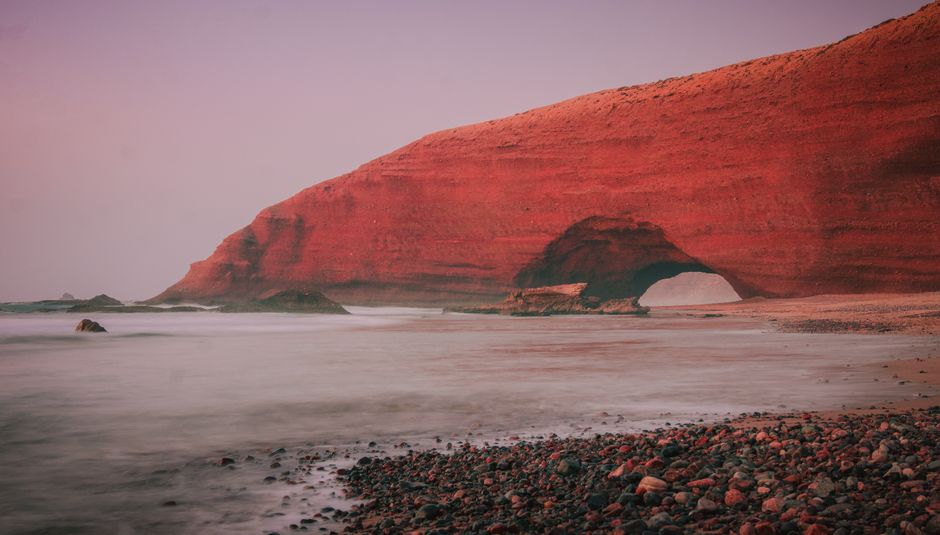
Stunning view of a large red rock arch on a misty beach during twilight, creating a serene atmosphere.
In Guelmim-Oued Noun, Sidi Ifni connects south coast and architecture.
A sense of place
Sidi Ifni is a southern Atlantic town with sea cliffs, Spanish-era architecture, blue-white urban details, cafés, fishing life, nearby beaches and access to Mirleft, Legzira and Guelmim routes. Sidi Ifni's value is atmosphere: it feels slower, more remote and more architectural than many coastal stops. Sidi Ifni connects naturally with Mirleft, Aglou, Legzira setting, Guelmim, Fort Bou Jerif and southern road trips.
Sidi Ifni adds a distinctive southern coastal identity.
The appeal of Sidi Ifni comes from the meeting of art deco Atlantic town, Atlantic cliffs, and spanish-era architecture, not from a single attraction.
From Sidi Ifni, the itinerary connects naturally to the broader pattern of Anti-Atlas foothills, Sahara-edge oases and wild southern Atlantic roads.
This combination gives Sidi Ifni a clear role in the wider Moroccan itinerary.
A useful visit is built around art deco Atlantic town, Atlantic cliffs, and spanish-era architecture.

In Guelmim-Oued Noun, Guelmim connects south gateway and food.
A sense of place
Guelmim is a gateway to southern Morocco, linking camel-market memory, Tighmert oasis, Sidi Ifni, Fort Bou Jerif, Plage Blanche, Assa and Sahara-edge routes. It supports drivers, guesthouses, market guides, oasis routes and overland logistics.
For many visitors, Guelmim becomes a gateway, stopover or base for onward travel; the surrounding streets, roads and services then determine how long the stop deserves.
From Guelmim, the itinerary connects naturally to the broader pattern of Anti-Atlas foothills, Sahara-edge oases and wild southern Atlantic roads.
This combination gives Guelmim a clear role in the wider Moroccan itinerary.
A useful visit is built around south gateway and camel-market city, tighmert oasis, and desert-edge routes.
Stop 6
Tarfaya

The remains of the Casa Mar fortress built by the British in the 1880s in Tarfaya, Morocco.
Tarfaya links an Atlantic townscape with the history of early airmail. Antoine de Saint-Exupéry became station chief at Cap Juby, today’s Tarfaya, in 1927. That aviation connection gives a coastal stop here a story beyond the beach. Explore the town and shoreline, then check local arrangements for the Saint-Exupéry museum or memorial.
Tarfaya links an Atlantic townscape with the history of early airmail. Antoine de Saint-Exupéry became station chief at Cap Juby, today’s Tarfaya, in 1927. That aviation connection gives a coastal stop here a story beyond the beach.
Explore the town and shoreline, then check local arrangements for the Saint-Exupéry museum or memorial. Plan onward travel around confirmed road connections and current services. Allow time to appreciate the coast without assuming that a historic sea link still provides a passenger ferry.

In Laayoune-Sakia El Hamra, Laayoune connects sahara and food.
A sense of place
Laayoune is a southern urban gateway connecting Foum El Oued, El Marsa, Smara, Tarfaya and the long Atlantic road toward Dakhla. Important distinctions include it as a practical regional base for business, coastal evenings, Sahara road trips and southern logistics.
Within Laayoune-Sakia El Hamra, Laayoune is defined by southern regional capital, regional services, and foum el oued, giving it a role that is different from the region’s better-known stops.
The most useful regional connection is through Laayoune, which places the experience within Sahara-Atlantic cities, fishing ports, lagoons and long-distance coastal routes.
The experience gains depth through southern regional capital, regional services, and foum el oued, which can be explored at different speeds depending on the season, the traveler and the wider route.

Choose between Dakhla’s city life, a lagoon sports stay, Atlantic surfing and separate inland excursions. Understand the exact location, transfers and activity arrangements before booking the trip.
Choose your setting before your room
A Dakhla stay can centre on the city, accommodation beside the lagoon or a programme of separate excursions. Those choices lead to different days. If town walks and meals out matter most, compare the trip into the city from your lodging. If water sports are central, compare the activity provider’s launch and meeting arrangements with your accommodation.
Look at the full address and the map rather than assuming every place described as Dakhla sits beside the same beach. Ask how meals, transfers and equipment are handled. A room price and a package built around instruction may include quite different things.
Choose between three different landscapes
Think of the stay in three parts: the city and peninsula, the lagoon, and a separately reached inland landscape. A lagoon-focused stay can combine instruction with quiet time beside the water; a town-focused stay makes room for meals and streets beyond the sports programme. On the Atlantic side, surfing introduces another coastline and another set of conditions. The point is to choose which setting you want to spend time in, rather than give every excursion equal weight.
The regional tourism office presents oyster cultivation as one of Dakhla’s food interests and Imlili as a distinct wetland ecosystem in the desert. They invite different questions: how seafood is cultivated and prepared, or how water supports life in an arid setting. Choosing one subject makes an excursion more meaningful than treating both places as brief stops for photographs.
Understand the activity you are arranging
Instruction, equipment rental and independent practice ask different things of a participant. Explain your experience before agreeing a session, and ask what supervision and equipment are included. The provider should help choose a location appropriate to the conditions and your ability.
The lagoon and Atlantic surf coast are different environments. Pointe de l’Or belongs to an Atlantic outing, with its own approach and meeting point. Keep the actual entry location agreed with the operator; a broad city or regional pin cannot stand in for it. Leave flexibility if conditions require changing the session.
Stop 9
Dakhla Lagoon: shores, wind sports and wildlife

Kitesurfing on the lagoon near Dakhla’s dunes.
Dakhla's lagoon is a coastal landscape with several different shorelines and places to stay. Compare the city, lagoon camps and Atlantic-facing beaches before choosing a visit: water sports, seafood and wildlife watching each need their own location and arrangements.
Choosing where to stay
A stay in Dakhla city gives a different starting point from accommodation along the lagoon. Choose around the places and activities you want to reach, then check the actual road transfer. An Atlantic surf beach and a lagoon launch are different settings.
Water sports
Wind and tide shape the activity. Ask the school which launch it uses, what experience is required and what equipment, supervision and transfers are included. An attractive lagoon photograph does not establish that a particular session is operating.
Wildlife and food
The bay is a Ramsar wetland. Watch wildlife without approaching resting or nesting birds, and follow local access instructions. Birdwatching around Dakhla separates wetland and desert habitats. Explore Dakhla oysters for food context and confirm a restaurant or farm visit separately.
Travelling between your stops
Compare the connections below when deciding where to stay and how much of each day to leave for visits. Driving estimates exclude traffic, breaks and time at attractions. Dated timetable references describe the collected services; check your travel date with the operator.
Agadir → Tiznit
Road · 92.8 km · 1 h 31 min
Estimated drive on the mapped road network. Travel time on site is additional.
Map and routing attributionTiznit → Mirleft
Road · 42.5 km · 46 min
Estimated drive on the mapped road network. Travel time on site is additional.
Map and routing attributionMirleft → Sidi Ifni
Road · 31.5 km · 40 min
Estimated drive on the mapped road network. Travel time on site is additional.
Map and routing attributionSidi Ifni → Guelmim
Road · 54.9 km · 1 h 3 min
Estimated drive on the mapped road network. Travel time on site is additional.
Map and routing attributionGuelmim → Tarfaya
Road · 342.3 km · 4 h 14 min
Estimated drive on the mapped road network. Travel time on site is additional.
Map and routing attributionTarfaya → Laayoune
Road · 121.7 km · 2 h 1 min
Estimated drive on the mapped road network. Travel time on site is additional.
Map and routing attributionLaayoune → Dakhla
Road · 535.7 km · 6 h 57 min
Estimated drive on the mapped road network. Travel time on site is additional.
Map and routing attributionDakhla → Dakhla Lagoon
Road · 37.8 km · 40 min
Estimated drive on the mapped road network. Travel time on site is additional.
Map and routing attribution
Make this itinerary yours
Add these stops to your current itinerary, then adjust the order and your travel preferences. This does not book transport, accommodation or activities.
Recheck transport, tickets, opening hours and access before travel.