 Itineraries
Marrakech with Ourika, Moulay Brahim, Imlil · 9-day road itinerary
Start and finish in Marrakech, visiting Ourika, Moulay Brahim, Imlil, Bin El Ouidane and Ouzoud. 8 stops across 9 days.
Jemaa el-Fnaa and the Marrakech skyline at sunset.
Along your itinerary
Places you’ll discover
This itinerary includes a full story and ordered stops. Check access, timetables and closures again before travel.
Road itinerary
Road itinerary distance and travel time are available for the full stop sequence.
Other road options
Compare road alternatives before choosing this day’s connection.
Open a day to read its visits, practical details and travel connections.
Before you go
Get to know the places on your itinerary
Read what makes each place worth a visit and choose how you want to spend your time there. The stop sequence above keeps your day assignments; these guides help you shape the visits.
Stops 1 & 6 & 8
Marrakech
Jemaa el-Fnaa and the Marrakech skyline at sunset.
Explore Marrakech through connected medina walks, gardens and historic buildings, then choose whether an Atlas or Atlantic extension belongs in your trip. Leave time for the city between its landmarks.
Find your rhythm before filling the itinerary
Marrakech rewards a plan with a little space in it. The medina, gardens, historic buildings and newer neighbourhoods offer different ways to spend a day. Choose the part of the city that interests you most, then build a walk around a few nearby visits. The UNESCO-listed medina is a living urban place, with homes and working streets between its major sights.
For an initial outing, use Jemaa el Fna as a point of orientation and explore the medina at a pace that leaves room to stop. Return to a familiar meeting point rather than turning every lane into another item to complete. If shopping is important, give it its own time so that a museum or garden booking does not become a deadline hanging over the walk.
Recognise the layers of the old city
Marrakech began as an Almoravid foundation in the eleventh century and developed through successive dynasties. That history is visible at different scales: the Koutoubia as a city landmark, the defensive circuit of walls and gates, and the more enclosed settings of palaces, tombs and religious learning. Ben Youssef Madrasa, the Badi Palace and the Saadian Tombs each offer a different architectural subject. Choose the one that most interests you rather than expecting three interiors to tell the same story.
Try looking at one material as you walk: cut tile, carved plaster, wood or garden water. Following a detail from a major building into an ordinary courtyard helps connect monumental Marrakech to its domestic architecture. Keep the square and souks for another part of the outing, when you can enjoy their activity without rushing toward a closing door.
Give each major visit a clear place in the day
Choose a garden or historic interior because you want to spend time there. Jardin Majorelle has its own visitor arrangements; check them before planning the rest of the day around it. The Menara gardens offer a different setting from the medina. Gueliz and Hivernage introduce another part of Marrakech, with wider streets and a different urban atmosphere.
Avoid combining distant visits solely because they appear on the same must-see list. Compare their exact locations and leave time for the connecting trip, a meal and a rest. Travellers who prefer a gentler pace can choose one main visit and an unhurried neighbourhood walk rather than several separate transfers.
Stop 2
Ourika
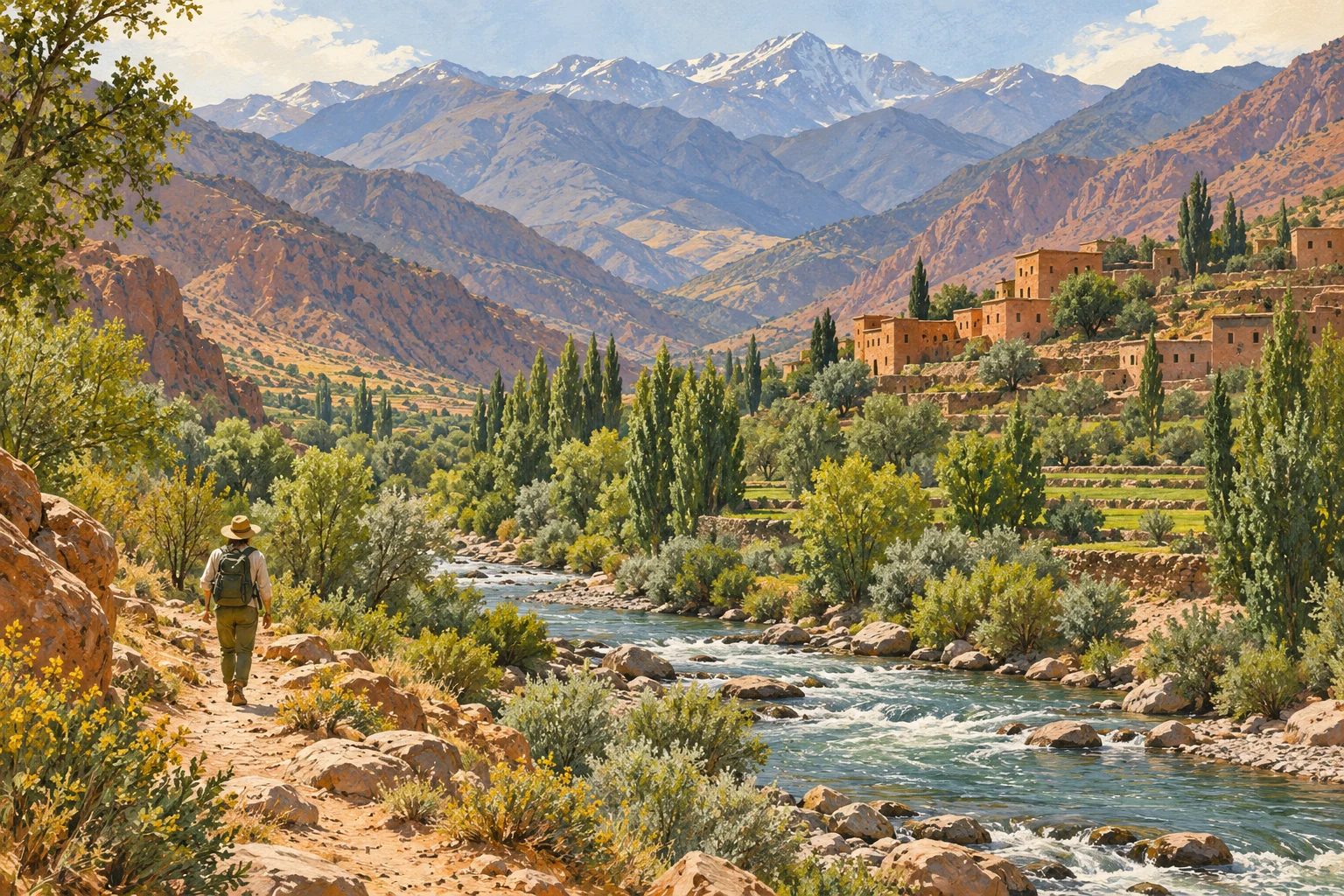
Editorial illustration of High Atlas valley travel themes for Ourika.
Ourika is the valley gateway that organizes routes from Marrakech toward Setti Fatma, gardens, riverside restaurants and Atlas villages. It should distinguish the town and valley from individual attractions.
A sense of place
Ourika is the valley gateway that organizes routes from Marrakech toward Setti Fatma, gardens, riverside restaurants and Atlas villages. It should distinguish the town and valley from individual attractions.

Moulay Brahim — Foothill stop between Marrakech, Asni and the High Atlas valleys.
Connections across Morocco
Foothill stop between Marrakech, Asni and the High Atlas valleys
Stop 4
Imlil

This is an image with the theme "Home + Habitat in Africa" from:
In Marrakech-Safi, Imlil connects trekking and High Atlas.
A sense of place
Imlil is Morocco’s most recognizable High Atlas trekking base, especially for routes toward Toubkal and surrounding villages. Travelers need to understand altitude, weather, walking level, guides, mules, guesthouses, village etiquette, seasonal conditions and transfer planning from Marrakech.
Imlil is one of the strongest examples of a public mountain landscape supported by local services.
A strong itinerary gives priority to High Atlas trekking village, toubkal gateway, and mountain guides, using the rest of the visit to support rather than distract from those defining qualities.
Travelling between your stops
Compare the connections below when deciding where to stay and how much of each day to leave for visits. Driving estimates exclude traffic, breaks and time at attractions. Dated timetable references describe the collected services; check your travel date with the operator.
Marrakech → Ourika
Road · 35.4 km · 47 min
Estimated drive on the mapped road network. Travel time on site is additional.
Map and routing attributionOurika → Moulay Brahim
Road · 36.6 km · 43 min
Estimated drive on the mapped road network. Travel time on site is additional.
Map and routing attributionMoulay Brahim → Imlil
Road · 21.9 km · 33 min
Estimated drive on the mapped road network. Travel time on site is additional.
Map and routing attributionImlil → Bin El Ouidane
Road · 272.7 km · 4 h 44 min
Estimated drive on the mapped road network. Travel time on site is additional.
Map and routing attributionBin El Ouidane → Marrakech
Road · 211.9 km · 3 h 31 min
Estimated drive on the mapped road network. Travel time on site is additional.
Map and routing attributionMarrakech → Ouzoud
Road · 159.6 km · 3 h 1 min
Estimated drive on the mapped road network. Travel time on site is additional.
Map and routing attributionOuzoud → Marrakech
Road · 160.2 km · 3 h 2 min
Estimated drive on the mapped road network. Travel time on site is additional.
Map and routing attribution
Make this itinerary yours
Add these stops to your current itinerary, then adjust the order and your travel preferences. This does not book transport, accommodation or activities.
Recheck transport, tickets, opening hours and access before travel.